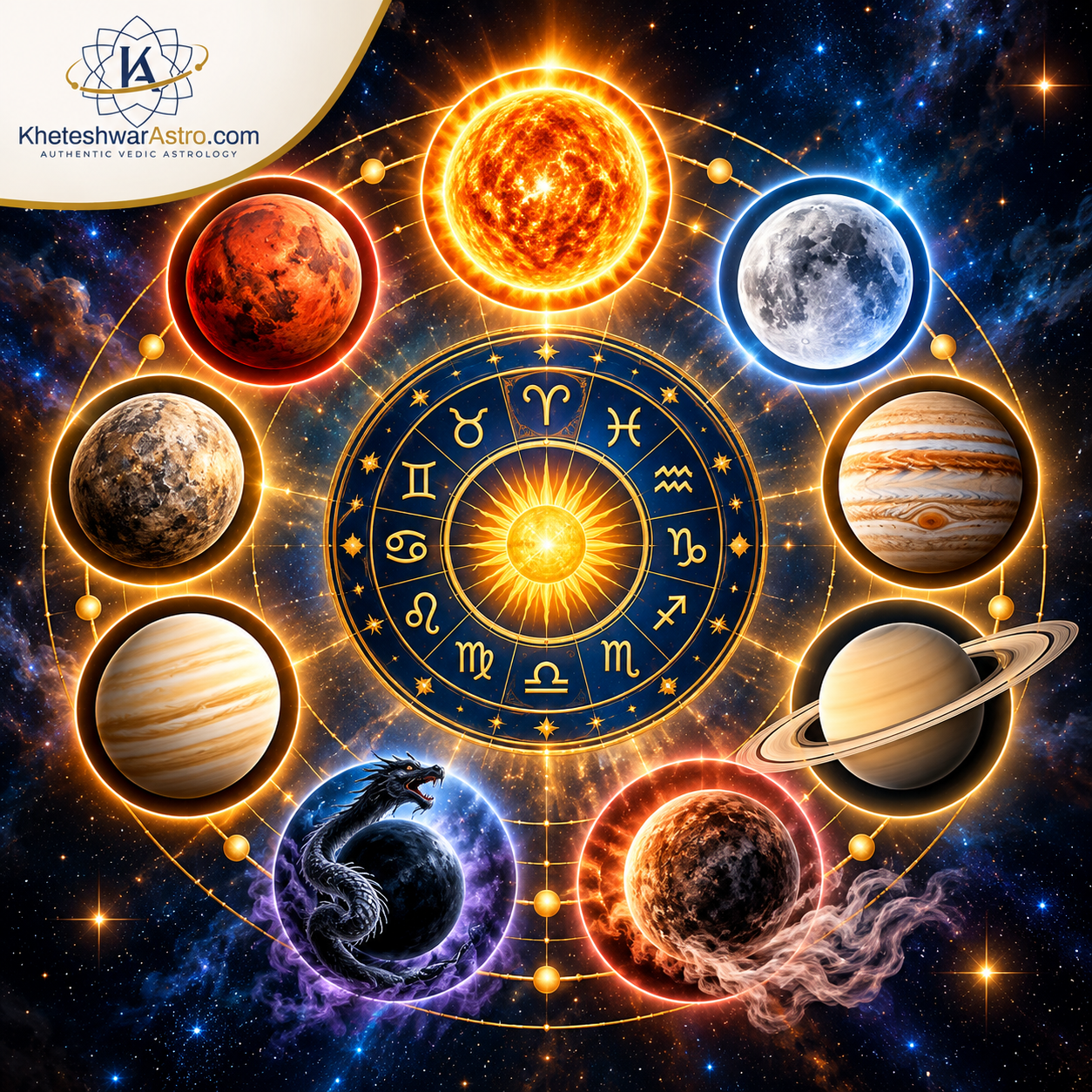

A Child Kundali is a Vedic Astrology birth chart prepared using a child’s exact date, time, and place of birth. It is traditionally studied to understand a child’s personality, natural talents, education, health tendencies, interests, relationships, and important developmental phases.
Child astrology should not be used to put fixed labels on a child. Every child has unique potential, and the purpose of Kundali analysis is to understand that potential and provide supportive guidance.
What Is Child Astrology?
Child Astrology focuses on understanding the planetary influences present at the time of birth.
Parents may use a Kundali analysis to explore questions such as:
- What are my child's natural strengths?
- Which subjects may interest the child?
- Is the child more creative, analytical, practical, or communicative?
- What kind of learning environment may suit them?
- Which career areas could match their natural abilities?
- How can parents better understand their child's personality?
- What periods may require additional attention and support?
Important Houses in a Child's Kundali
1. 1st House – Personality & Overall Nature
The 1st House (Lagna) represents the child's basic personality, temperament, confidence and general approach toward life.
A strong Lagna and Lagna Lord are traditionally considered supportive of overall development.
2. 2nd House – Speech & Family Values
The 2nd House is associated with:
- Speech
- Communication style
- Family environment
- Early values
- Accumulated knowledge
It can provide insights into how a child expresses themselves.
3. 4th House – Education & Emotional Foundation
The 4th House is particularly important for childhood because it represents:
- Early education
- Mother and nurturing environment
- Emotional comfort
- Home environment
- Basic learning foundation
A supportive 4th House can indicate a favourable environment for learning and emotional development.
4. 5th House – Intelligence & Talent
The 5th House is one of the most important houses in Child Astrology.
It is traditionally associated with:
- Intelligence
- Learning ability
- Creativity
- Memory
- Academic interests
- Hobbies
- Talent
- Logical and analytical abilities
The 5th Lord and Jupiter should be carefully examined while assessing education and intellectual potential.
5. 9th House – Higher Education & Knowledge
The 9th House is associated with:
- Higher education
- Advanced knowledge
- Teachers and mentors
- Fortune
- Philosophy
- Long-term learning
Its condition can provide additional insight into the child's educational journey.
6. 10th House – Career Potential
As the child grows, the 10th House becomes important for understanding professional interests and career direction.
However, parents should avoid deciding a child's career too early solely on the basis of a Kundali.
Role of Important Planets in Child Astrology
Sun – Confidence & Leadership
The Sun is associated with confidence, individuality, authority and leadership qualities.
A strong Sun may indicate a child who enjoys taking responsibility or leading others.
Moon – Emotions & Mental Nature
The Moon represents emotional nature, sensitivity, imagination and mental patterns.
The Moon's strength can be considered when understanding how a child responds emotionally to different situations.
Mercury – Intelligence & Communication
Mercury is associated with:
- Communication
- Logical thinking
- Mathematics
- Writing
- Analytical ability
- Curiosity
It can be especially relevant when analysing a child's learning and communication style.
Jupiter – Wisdom & Knowledge
Jupiter represents wisdom, learning, guidance and higher knowledge.
It is an important planet when studying education and intellectual development.
Venus – Creativity & Artistic Talent
Venus can be associated with:
- Music
- Art
- Design
- Beauty
- Creativity
- Performing arts
Mars – Energy & Competitive Spirit
Mars represents physical energy, courage, initiative and competitive nature.
A strong Mars can indicate an energetic child who enjoys sports, challenges and active pursuits.
Saturn – Discipline & Patience
Saturn is associated with discipline, responsibility, patience and perseverance.
Its influence may sometimes indicate that a child develops certain abilities gradually rather than immediately.
Child Kundali & Education
Education is one of the most common reasons parents consult astrology.
Astrologers traditionally examine:
4th House + 5th House + 9th House + Mercury + Jupiter
along with their respective lords and planetary periods.
The purpose should not be to predict a fixed academic result, but to understand possible strengths and suitable learning approaches.
For example, one child may naturally enjoy numbers and logic, while another may perform better in language, creativity, communication or practical activities.
Child Kundali & Career Potential
A child's career should never be decided solely from a Kundali at a young age.
Instead, astrology can be used as one traditional framework for understanding potential interests.
Depending on the planetary combinations, a child may show stronger inclinations toward areas such as:
- Business & Entrepreneurship
- Technology
- Medicine
- Research
- Finance
- Law
- Management
- Communication
- Media
- Art & Design
- Sports
- Education
- Spirituality
- Public Administration
The child's actual interests, education, skills and choices should always remain the priority.
Child Astrology & Personality
A Kundali may also be studied to understand whether a child is naturally:
- Introverted or socially expressive
- Analytical or creative
- Calm or highly energetic
- Independent or collaborative
- Emotionally sensitive
- Curious and experimental
- Competitive
- Leadership-oriented
Understanding these tendencies can help parents create a more supportive environment.
Child Kundali and Health
Traditional Vedic Astrology also examines certain houses and planets for health tendencies.
However, astrology cannot diagnose medical conditions.
If a child has any health concern, parents should always consult a qualified pediatrician or medical professional. Astrology may only be considered a traditional spiritual or cultural framework.
Dasha and Important Life Periods
The Mahadasha and Antardasha system can be used to understand different developmental periods in a child's life.
Different planetary periods may correspond traditionally with changes in:
- Education
- Interests
- Confidence
- Skills
- Friendships
- Achievements
- Responsibilities
The timing should always be interpreted together with the complete Kundali rather than from one planet alone.
What Parents Should Avoid
Child Astrology should be used carefully.
Parents should avoid telling a child:
❌ “You will never succeed.”
❌ “You are weak in studies.”
❌ “You can only become a particular profession.”
❌ “You have a bad Kundali.”
Such statements can negatively influence a child's confidence.
Instead, astrology should be used to identify strengths, opportunities and areas where additional support may be helpful.
Can Rudraksha Be Recommended for Children?
Rudraksha may traditionally be recommended according to the child's Kundali and individual requirements.
However, the selection should be thoughtful and age-appropriate. Rudraksha should be viewed as a spiritual/astrological practice, not as a replacement for medical, educational or psychological support.
What Details Are Required for Child Kundali Analysis?
For a detailed analysis, the astrologer generally requires:
Date of Birth
Exact Time of Birth
Place of Birth
Accurate birth time is particularly important because the Lagna and house placements can change with time.
Benefits of Child Kundali Analysis
A thoughtful Child Kundali analysis may help parents:
Understand their child's natural personality
Identify possible learning strengths
Understand intellectual and creative tendencies
Recognise areas of natural talent
Explore possible future career interests
Understand emotional tendencies
Build better parent-child communication
Understand important developmental periods
Explore traditional spiritual remedies when appropriate