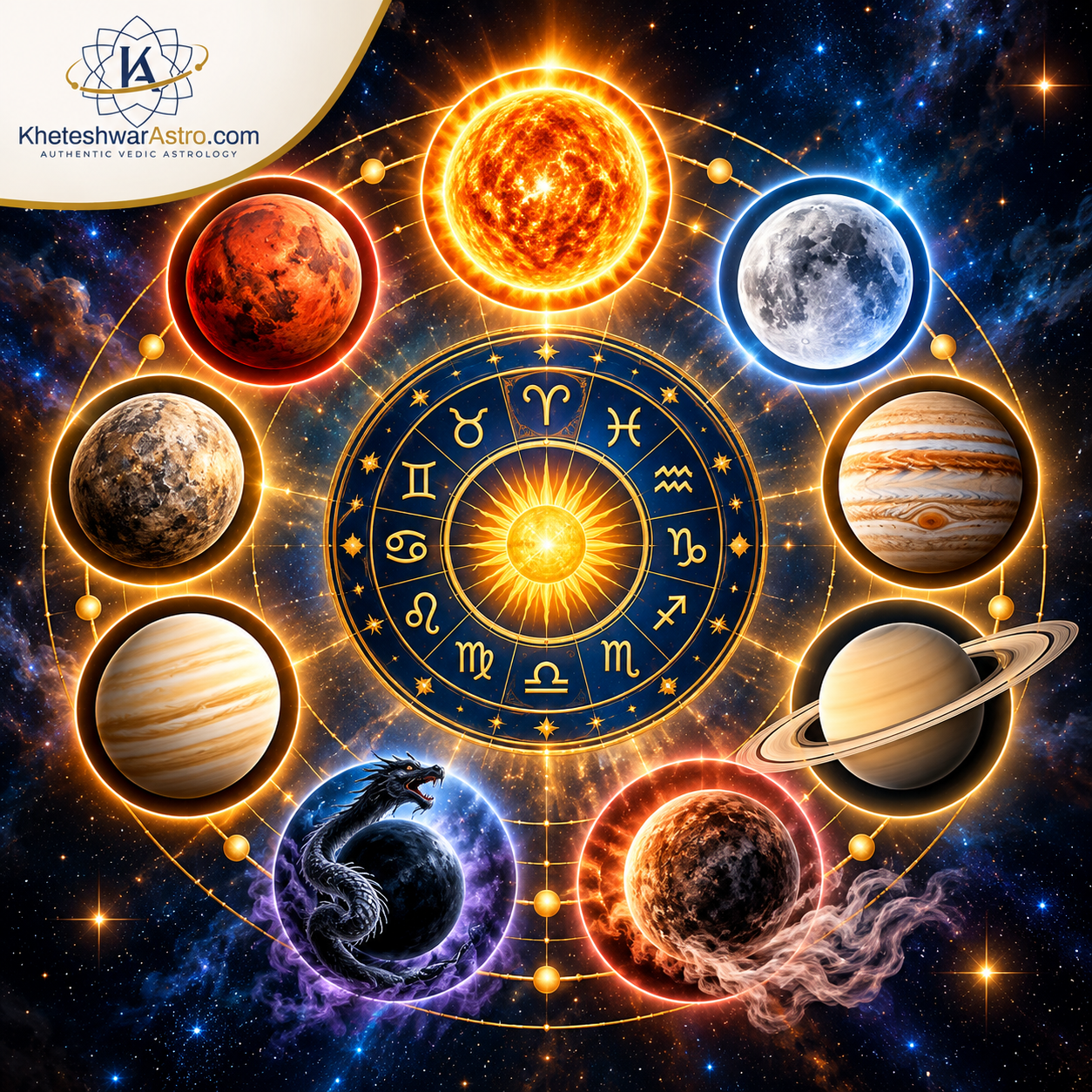

In Vedic astrology, the nine celestial influences, known as the Navagraha, play an important role in interpreting a person's birth chart or Kundli. The nine Grahas are the Sun, Moon, Mars, Mercury, Jupiter, Venus, Saturn, Rahu, and Ketu. Each Graha represents different themes of life, including personality, emotions, career, relationships, knowledge, responsibilities, and spiritual growth.
In traditional Vedic astrology, the placement of these Grahas in different houses and zodiac signs is interpreted alongside their aspects, conjunctions, planetary strength, and Dasha periods. No planet should be considered entirely beneficial or harmful without examining the complete birth chart.
This guide explains the meaning of all nine planets, their traditional effects, signs of challenging placements, and commonly followed spiritual remedies.
1. Sun (Surya) in Vedic Astrology
The Sun represents the soul, self-confidence, authority, leadership, vitality, recognition, and the relationship with one's father in traditional Vedic astrology. It is associated with personal identity, responsibility, and the ability to take initiative.
When the Sun is considered well-placed in a birth chart, it is traditionally associated with leadership qualities, confidence, determination, and a strong sense of responsibility. A challenging Sun placement may be interpreted as a tendency toward excessive pride, conflicts with authority, or difficulties expressing confidence. These interpretations depend on the Ascendant, house placement, sign, aspects, and planetary periods.
Traditional Sun Remedies: Offer water to the rising Sun, practice a disciplined daily routine, and recite the Sun mantra.
Sun Mantra: Om Ghrini Suryaya Namah.
2. Moon (Chandra) in Vedic Astrology
The Moon represents the mind, emotions, intuition, sensitivity, nurturing, and the relationship with one's mother in Vedic astrology. It is also important in the traditional interpretation of emotional responses and mental inclinations.
A well-placed Moon is traditionally associated with emotional awareness, adaptability, compassion, and a nurturing nature. A challenging Moon placement may be interpreted as emotional sensitivity, fluctuating moods, or difficulty maintaining emotional balance. Such astrological interpretations are not medical assessments and should not be used to diagnose mental health conditions.
Traditional Moon Remedies: Worship Lord Shiva on Mondays, practice meditation, and cultivate a peaceful daily routine.
Moon Mantra: Om Somaya Namah.
3. Mars (Mangal) in Vedic Astrology
Mars represents courage, energy, determination, action, competition, property, and technical ability. It is associated with initiative, ambition, and the way a person responds to challenges.
A well-placed Mars is traditionally linked with courage, decisiveness, discipline, and the ability to take action. A challenging placement may be interpreted as impatience, impulsiveness, anger, or conflicts. Mars is also considered in traditional marriage compatibility analysis, particularly in discussions of Manglik Dosha. However, its significance must be assessed within the complete chart rather than in isolation.
Traditional Mars Remedies: Worship Lord Hanuman on Tuesdays, recite the Hanuman Chalisa, and practice patience and constructive management of anger.
Mars Mantra: Om Mangalaya Namah.
4. Mercury (Budh) in Vedic Astrology
Mercury represents intelligence, communication, reasoning, learning, mathematics, writing, business, and analytical skills. In traditional astrology, it is associated with how a person processes information and expresses ideas.
A well-placed Mercury is traditionally linked with clear communication, adaptability, logical thinking, and commercial awareness. A challenging Mercury placement may be interpreted as indecision, misunderstandings, nervousness in communication, or difficulty organizing information.
Mercury's results are interpreted according to its sign, house, conjunctions, aspects, and relationship with other planetary factors.
Traditional Mercury Remedies: Worship Lord Ganesha on Wednesdays, support students, and practice clear and thoughtful communication.
Mercury Mantra: Om Budhaya Namah.
5. Jupiter (Guru or Brihaspati) in Vedic Astrology
Jupiter represents wisdom, knowledge, education, ethics, spirituality, guidance, generosity, and expansion. It is traditionally considered an important benefic planet in Vedic astrology, although its results depend on the individual birth chart.
A well-placed Jupiter is associated with wisdom, optimism, ethical judgment, learning, and the ability to guide others. A challenging placement may be interpreted as excessive optimism, impractical expectations, or difficulty applying knowledge effectively.
Jupiter is also considered in traditional analyses of marriage, education, children, and prosperity, with the relevant houses and chart factors varying according to the question and the individual's chart.
Traditional Jupiter Remedies: Respect teachers and mentors, support educational activities, and recite the Jupiter mantra on Thursdays.
Jupiter Mantra: Om Brihaspataye Namah.
6. Venus (Shukra) in Vedic Astrology
Venus represents love, relationships, marriage, beauty, creativity, music, luxury, comfort, and aesthetic appreciation. It is traditionally associated with pleasure, harmony, and the enjoyment of material and artistic pursuits.
A well-placed Venus is linked with artistic interests, appreciation of beauty, affection, and a desire for harmony in relationships. A challenging Venus placement may be interpreted as excessive spending, attachment to luxury, relationship difficulties, or an imbalance between pleasure and responsibility.
Venus is an important factor in traditional relationship analysis, but marriage and compatibility cannot be reliably assessed from Venus alone.
Traditional Venus Remedies: Worship Goddess Lakshmi on Fridays, maintain cleanliness, appreciate art and beauty, and treat partners with respect.
Venus Mantra: Om Shukraya Namah.
7. Saturn (Shani) in Vedic Astrology
Saturn represents discipline, responsibility, patience, hard work, limitations, perseverance, and long-term consequences. In traditional Vedic astrology, Saturn is associated with the lessons that come through sustained effort and accountability.
A well-placed Saturn is traditionally linked with patience, reliability, practical thinking, and the ability to work consistently toward long-term goals. A challenging placement may be interpreted as delays, heavier responsibilities, obstacles, or the need to develop greater discipline.
Saturn is also associated with Sade Sati and Dhaiya in popular Vedic astrology. These periods should not automatically be treated as periods of misfortune; traditional interpretations depend on the complete birth chart and planetary periods.
Traditional Saturn Remedies: Help people in need, respect workers and elderly people, fulfill responsibilities honestly, and recite the Saturn mantra on Saturdays.
Saturn Mantra: Om Shanaishcharaya Namah.
8. Rahu in Vedic Astrology
Rahu is classified as a shadow Graha in Vedic astrology. Astronomically, it represents the Moon's ascending node, where the Moon's orbital path intersects the apparent path of the Sun. Rahu is not a physical planet.
In traditional astrology, Rahu is associated with ambition, material desires, unconventional approaches, foreign connections, technology, public recognition, and intense curiosity.
A favorably interpreted Rahu placement may be associated with innovative thinking, ambition, and interest in unconventional fields. A challenging placement may be interpreted as confusion, unrealistic expectations, excessive risk-taking, or an intense desire for recognition.
Rahu's interpretation depends on its house, sign, nakshatra, conjunctions, aspects, and the broader chart.
Traditional Rahu Remedies: Worship Goddess Durga, practice meditation, and carefully evaluate important decisions rather than acting on fear or impulse.
Rahu Mantra: Om Rahave Namah.
9. Ketu in Vedic Astrology
Ketu is the descending lunar node and is also classified as a shadow Graha. Like Rahu, it is an astronomical point rather than a physical planet.
Ketu is traditionally associated with detachment, introspection, spiritual inquiry, unconventional understanding, and the desire to look beyond material attachments.
A favorably interpreted Ketu placement may be linked with spiritual curiosity, deep study, and introspective thinking. A challenging placement may be interpreted as dissatisfaction, withdrawal, uncertainty, or difficulty finding direction in a particular area of life.
Ketu is often interpreted in relation to Rahu because the two lunar nodes lie opposite one another in the birth chart.
Traditional Ketu Remedies: Worship Lord Ganesha, develop a regular meditation practice, and help people in need.
Ketu Mantra: Om Ketave Namah.
How Do the Nine Planets Affect a Birth Chart?
In Vedic astrology, a planet's interpretation depends on several factors rather than its sign alone. Astrologers traditionally consider the following elements:
Ascendant (Lagna): The rising sign used as an important reference point for interpreting the chart.
House placement: The area of life associated with the house occupied by a planet.
Zodiac sign: The sign in which the planet is placed.
Planetary aspects: The traditional aspects a planet casts on other houses or planets.
Conjunctions: The combined interpretation of planets occupying the same sign or house.
Planetary strength: Factors such as dignity, exaltation, debilitation, and other traditional strength calculations.
Dasha and Antardasha: Planetary periods used in traditional timing techniques.
Divisional charts: Additional charts, such as the Navamsha, used for specific areas of interpretation.
For example, career analysis may consider the tenth house, its lord, Saturn, the Sun, Mercury, Jupiter, and the relevant planetary periods. Relationship analysis may consider the seventh house, its lord, Venus, and other relevant factors. The appropriate factors depend on the question and the complete chart.
A single planetary placement should not be used to make definitive predictions about a person's future, marriage, health, or financial circumstances.
What Are the Traditional Remedies for the Nine Planets?
Vedic astrology traditions include mantras, prayers, charitable acts, fasting, and other devotional practices associated with the Navagraha. Common examples include offering water to the Sun, worshipping Lord Shiva for the Moon, praying to Lord Hanuman for Mars, and helping people in need in connection with Saturn.
These practices are followed according to personal faith and family or spiritual traditions. Their use should be guided by understanding rather than fear. No ritual, gemstone, or Rudraksha should be presented as a guaranteed way to change financial outcomes, cure an illness, or eliminate every difficulty.
If considering a gemstone or Rudraksha based on a birth chart, first understand the traditional recommendation, its cost, the product's authenticity, and whether it suits your personal preferences. Medical, financial, and other major life decisions should also take practical circumstances and qualified professional advice into account.
Frequently Asked Questions (FAQs)
1. What are the nine planets in Vedic astrology?
The nine Grahas are the Sun (Surya), Moon (Chandra), Mars (Mangal), Mercury (Budh), Jupiter (Guru or Brihaspati), Venus (Shukra), Saturn (Shani), Rahu, and Ketu.
2. Are Rahu and Ketu real planets?
No. Astronomically, Rahu and Ketu are the ascending and descending lunar nodes. Vedic astrology classifies them as shadow Grahas and assigns them symbolic interpretations.
3. Which planet represents wealth in Vedic astrology?
Traditional wealth analysis may consider Jupiter, Venus, Mercury, the second and eleventh houses, their lords, and other chart factors. There is no single planet that determines wealth independently.
4. Which planet is associated with career and profession?
Career analysis often considers the tenth house, its lord, Saturn, the Sun, Mercury, Jupiter, and relevant planetary periods. The specific interpretation depends on the complete birth chart.
5. Which planet represents marriage and relationships?
Venus is an important relationship significator in traditional astrology. The seventh house, its lord, Jupiter in relevant traditional contexts, and other chart factors may also be considered. Interpretations can vary according to the person's chart and the question being examined.
6. Can planetary remedies change a person's destiny?
Traditional astrology recommends certain spiritual practices as remedies, but their effects are not scientifically established as guaranteed ways to change outcomes. Prayer and charitable acts can be meaningful expressions of faith, while practical action remains important.
Conclusion
The nine Grahas form a central part of traditional Vedic astrology. The Sun is associated with identity and authority, the Moon with emotions, Mars with courage, Mercury with communication, Jupiter with wisdom, Venus with relationships and beauty, Saturn with discipline, Rahu with ambition, and Ketu with detachment and spiritual inquiry.
Their traditional interpretations depend on the complete birth chart, including house placement, zodiac sign, aspects, conjunctions, planetary strength, and Dasha periods. Understanding these factors offers a more comprehensive introduction to Vedic astrology than labeling individual planets as simply good or bad.
At KheteshwarAstro, readers can explore traditional Vedic astrology, Kundli analysis, and Rudraksha guidance to learn more about these practices. Individual recommendations require consideration of the person's complete birth chart and circumstances.